

Belfast International Festival of Performance Art, 2026
Sara Andrade Monteiro
Sara Andrade Monteiro (b. 1978, Lisbon, Portugal) is a Northern Ireland–based artist currently studying Fine Art at Belfast School of Art.
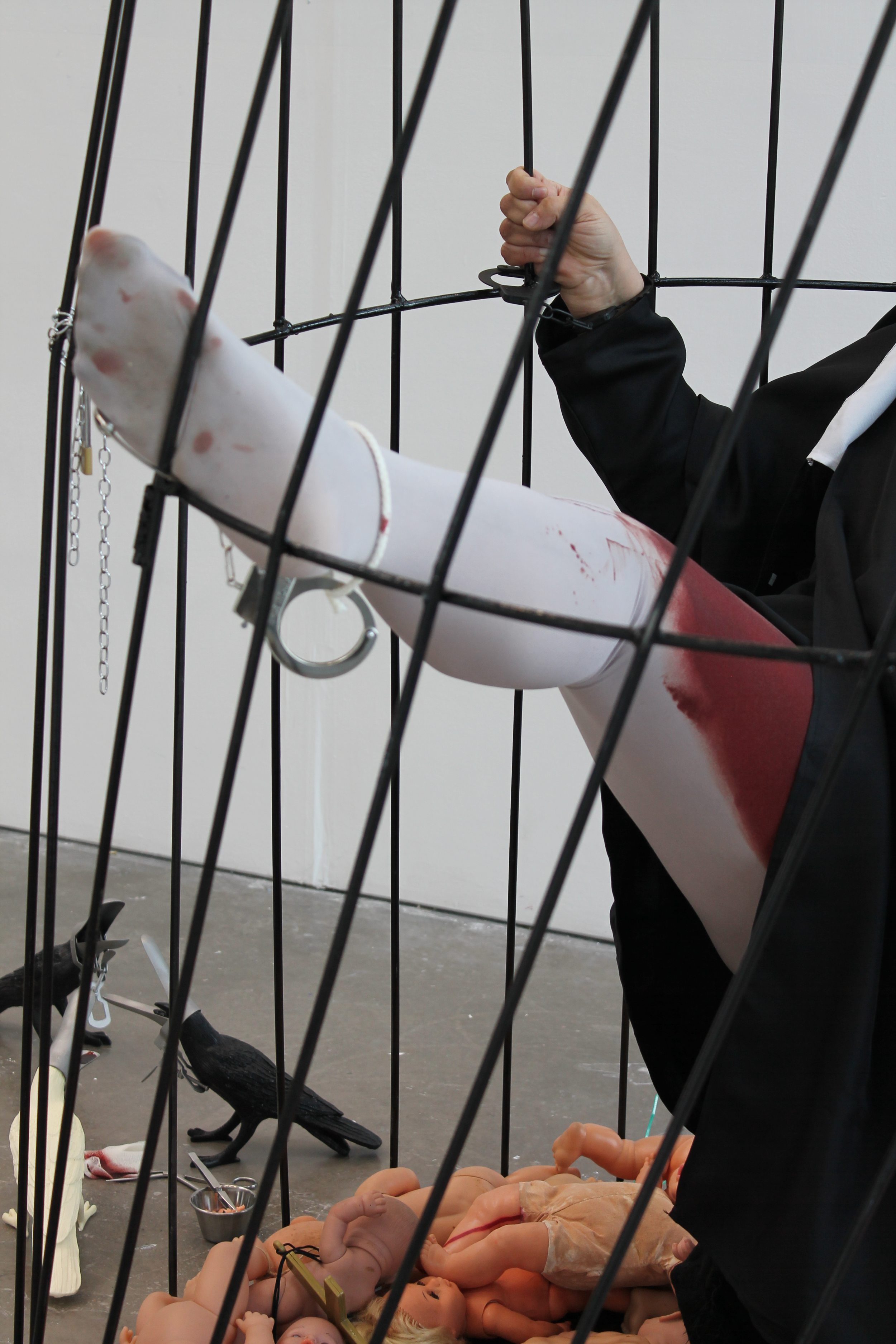
Working across performance, sculpture, sound, and lens-based media, her practice is grounded in lived experience and informed by trauma theory, with a focus on embodiment, memory, dissociation, and endurance. In recent years, she has increasingly focused on performance as a primary mode of inquiry, using the body as both material and site, often placing it in states of restriction, suspension, or prolonged stillness.
Her work explores states of containment, vulnerability, and transformation, often engaging with repetition, duration, and non-verbal forms of expression. Drawing on influences from ritual, horror cinema, dark humour, and contemporary performance practice, she creates environments that hold discomfort while allowing space for reflection and care. Through these works, she invites audiences into slow, emotionally charged encounters where meaning emerges over time rather than through spectacle.
Artist Statement
My practice begins where language breaks down.
I work with performance to explore trauma, memory, and the complex expectations placed on the body, especially the female body. My approach is rooted in presence, repetition, and endurance, often placing myself in physically or emotionally intense situations, through restriction, suspension, or prolonged stillness, to express what cannot be said with words.
I’m interested in the fragile spaces between vulnerability and resistance, the moment where stillness becomes a form of resistance, or silence becomes a confrontation. Drawing on personal experience, I use my body as a site of control and endurance, placing it under physical and emotional pressure to expose what cannot be spoken.
Influenced by ritual, horror cinema, shock aesthetics, and the rhythm of music and sound, I often work across multiple mediums including sculpture, moving image, sound, and installation. These elements sometimes become part of the performance itself, or remain as quiet traces of action.
For me, performance is a method of remembering and unlearning. It allows me to revisit what was hidden, express what was silenced, and examine the uneasy relationship between pain and meaning. Rather than creating a single resolved message, I seek to hold space for discomfort, and to invite others to witness it.